
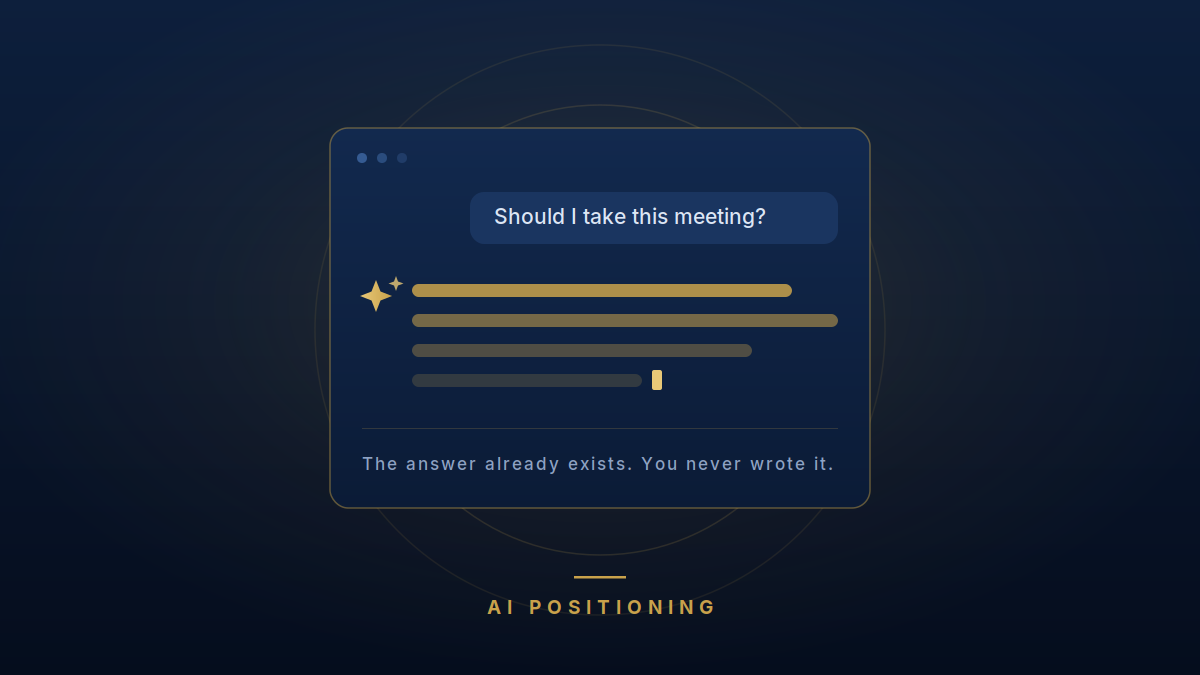
Open ChatGPT, Claude, or Gemini right now and type your own name, followed by your company. Read the answer carefully.
For most executives, that answer falls into one of three categories and all three are quietly costing them. Before we get there, it helps to understand why this matters at all. In an earlier article we showed that decisions are made before the first conversation: counterparties research you, form a judgment, and only then decide how seriously to treat the meeting.
That research used to mean a search engine and a LinkedIn profile. It now includes a question typed into an AI assistant and the assistant answers in full sentences, with confidence, whether or not the answer is accurate. AI positioning for executives exists because that answer has become part of your due diligence file, written by a system you never briefed.
The three answers AI gives about you
The empty answer. The assistant knows nothing, or produces two vague lines that could describe anyone. To a reader, absence reads as insignificance. An investor who asks about two potential partners and gets a substantive answer for one and a blank for the other has already felt a difference before checking a single fact.
The wrong answer. The assistant confuses you with someone of a similar name, attaches you to a company you left years ago, or states a role you never held. Few executives ever discover this, because few ever run the check. The counterparty who runs it for them rarely mentions what they found. They simply recalibrate.
The thin answer. The most common case. The assistant retrieves fragments an old bio, a conference listing, a line from a press release and assembles something technically accurate and strategically useless. Your actual authority, your track record, the scale you operate at: none of it surfaces, because none of it exists in a form these systems can read.
Whichever answer you received, notice one thing: you did nothing to produce it. It was generated from whatever public traces exist about you, weighted by sources you have never audited.
Why this layer is different from search
Executives learned years ago to care about their first page of Google results. AI answers behave differently in three ways that make them higher-stakes.
They are singular. A search page shows ten links and lets the reader judge. An assistant gives one synthesized answer, and the reader receives it as a summary of everything available.
They are trusted by default. People treat a fluent, confident paragraph differently from a list of links. The framing of the answer significant or marginal, credible or unclear transfers directly onto you.
They compound. These systems learn from what is published and repeated. The longer your public record stays thin or inconsistent, the more firmly the thin version becomes the canonical one. Waiting has a price that grows.
What shapes the answer
There is no dashboard where you edit what AI says about you. The answer is a reflection of your digital footprint: what has been published about you, where, how consistently, and with how much authority. A leader whose narrative appears coherently across their profiles, their company materials, credible third-party sources, and a body of substantive content gives these systems something solid to synthesize. A leader with scattered traces gives them nothing and gets nothing back.
This is why AI positioning cannot be separated from the rest of executive positioning. The answer AI gives is downstream of the same architecture: one narrative, expressed consistently across every surface that machines and people read. Fix the architecture, and the AI layer begins to correct itself. Ignore it, and no amount of posting activity will change what the assistant says.
Run the audit today
The first step costs ten minutes. Ask three different AI assistants who you are and what your company does. Save the answers. Then ask the question your next counterparty would actually ask “should I take a meeting with Digitalizit team?” and read what comes back.
Compare those answers against the level of conversations you intend to be in. If they would not survive being read aloud in front of the investor, board, or partner you want across the table, you have found a gap that is already pricing itself into your introductions.
Closing that gap deliberately, across every layer from LinkedIn to the answers machines give about you is what we do.
Digitalizeit builds executive positioning systems for leaders operating at institutional level, including AI positioning: auditing and shaping what AI assistants say when someone asks about you.

Leave a Reply